
GHSCO Newsletter

September 2025
Volume2 Number4
GHSCO Updates3
Ministry of Health Mongolia Visits KDCA to Strengthen ROK-Mongolia Cooperation in Infectious Disease Preparedness and Response
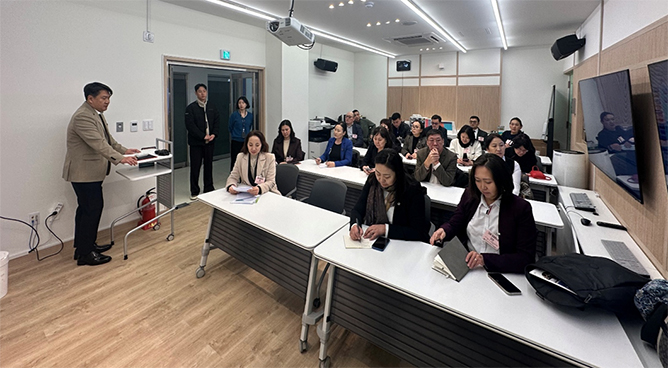
Korea Disease Control and Prevention Agency (KDCA) invited representatives from the Ministry of Health Mongolia to share Korea’s infectious disease response system on 8 December 2025. Tsetsegsaikhan Batmunkh, Director General in Public Health Policy and Implementation Department at the Ministry of Health, and directors of provincial-level health departments visited and engaged in a bilateral meeting with KDCA.
Official Development Assistance (ODA):
Mongolia Infectious Disease Response and Cooperation for Antimicrobial Resistance and Laboratory Empowerment (MIRACLE) Project

During the visit, KDCA shared key elements of Korea’s infectious disease surveillance system, and national immunization program, along with progress in ongoing Official Development Assistance (ODA) project with Mongolia. The Mongolian representatives provided an overview of their national health system. In the Q&A session, both shared priority actions on infectious diseases prevention and control, as well as updates on the establishment of Mongolia CDC. Additionally, they had an opportunity to tour KDCA’s Emergency Operations Center (EOC) and Biosafety Level 3 (BL3) Laboratory, receiving briefings on operational roles and functions. This visit helped strengthen bilateral collaboration by enhancing mutual understanding of each country’s public health systems and reaffirming the commitment to advance infectious disease preparedness and response capacities effectively.
 Site visit at Biosafety Level 3 Laboratory
Ongoing ODA Collaboration with Mongolia
Since 2023, the Mongolia ODA project—implemented with project partner Dr. Joon Sup Yeom, Director of the Center for Global Development at the Yonsei Institute for Global Health—has progressed in close collaboration with the National Center for Communicable Diseases (NCCD). Key activities include:
- Establishment of National Antimicrobial Resistance (AMR) Surveillance Network
- Strengthening NCCD National Laboratory Capacities
- Simulation Exercises for Emerging Infectious Diseases
- Field Epidemiology Training Program (Mentor)
Mongolia is currently developing AMR surveillance system at national level including major hospitals in Ulaanbaatar, along with plans to publish national AMR surveillance report.
Plans for 2026
Several activities are planned for 2026, including:
- Epidemiological Capacity Building Training on Healthcare-Associated Infection Control (April)
- Simulation Exercises for Emerging Infectious Diseases (May)
- Developing National Antimicrobial Susceptibility Testing Guideline (June)
KDCA will continue its close collaboration with Mongolia through Yonsei Institute for Global Health to ensure effective ODA implementation. Through sustained partnership, there will be tangible and meaningful outcomes for both countries.
