
GHSCO Newsletter

September 2025
Volume2 Number4
Partner Stories
Strengthening National Public Health Institutes for the Next Pandemic: Interview with IANPHI President Duncan Selbie
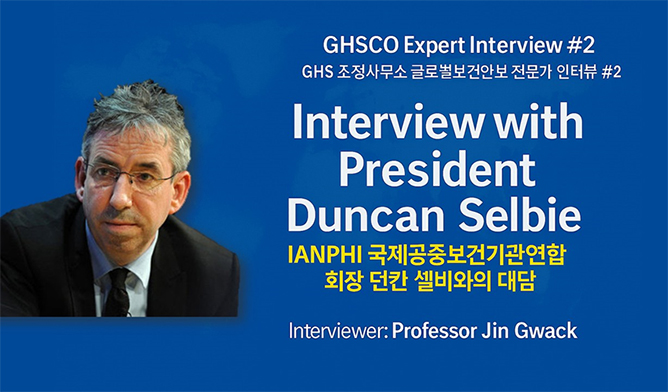 Click here to watch the full interview.
From Reactive to Proactive Preparedness in Response to Future Pandemics
Professor Duncan Selbie, President of the International Association of National Public Health Institutes (IANPHI), opened the discussion by underscoring the global lesson from COVID-19. President Selbie emphasized that the world needs to shift from reactive crisis management to proactive prevention. While emergency response capacity remains vital, he highlighted the need for “a better balance between response and prevention,” calling for more consistent public health capabilities across countries. He also highlighted the enhancement of the International Health Regulations (IHR) as the most significant structural priority for global health security.
“Take the International Health Regulations to heart.”
This principle, he said, should guide both future national strategies and international collaboration efforts.
Integrated Surveillance: The Most Urgent Priority for Next Pandemic
One of the major challenges revealed during COVID-19 was the inability of many countries to integrate diverse data sources—genomics, environmental monitoring, social behaviors, and clinical reports. President Selbie noted that even well-resourced countries faced challenges, as technical integration alone does not guarantee readiness. Drawing on IANPHI’s experience, he stressed the need for adaptable, collaborative models that allow countries—especially low- and middle-income countries—to combine essential data sources without requiring fully integrated systems.
Legal Authority and Mandates: Protecting the Scientific Voice
Another key lesson is the importance of clear legal mandates for NPHIs. President Selbie emphasized the need for institutional frameworks that guarantee NPHIs the authority to deliver evidence-based scientific findings without political interference.
“Freedom and protection of legal authority are a vital part of NPHIs.”
He emphasized that policymakers must balance public health with economic and social considerations, but also stressed that NPHIs should be empowered to deliver timely, transparent, and consistent evidence-based guidance.
Public Health Investment as an Insurance Premium
Referencing WHO Director-General Dr. Tedros’s description of the global “panic-neglect” cycle (often described as “panic-promise-respond-forget”), President Selbie warned that several countries are already scaling back public health investments only a few years after the peak of COVID-19.
“Pay your insurance premiums, because investing in public health is an investment in the protection of people, economic security, and national prosperity.”
He emphasized that consistent investment in NPHIs not only protects population health but also strengthens national economic security and long-term prosperity.
This interview highlights the indispensable role of NPHIs in shaping global readiness for the next health emergency. From implementing the IHR and developing integrated surveillance systems to securing legal mandates, the path forward requires strategic investment and unwavering political commitment.